

Den nedenstående artikel kommer fra Guruen Dr Elder, hvor han skriver ganske kort om hvad man skal passe på med at gøre på aktiemarkedet - Især i disse tider hvor markedet er enormt volatilt.
Dear Trader,
The stock market has become more volatile due to many fundamental uncertainties. Trading in 2010 is much harder than it was in 2009. Many traders are responding to the jumpiness of the market by shortening their horizons – switching to very short-term swing trading and even day-trading.
Today I would like to look into one of the techniques popular among experienced day-traders – doubling down on a losing position. This brings down the average cost and allows you to get out of a losing trade at a profit. This technique is absolutely deadly in inexperienced hands – all it will do is double up your losses. It is only recommended for experienced traders with excellent discipline. The piece that follows initially appeared on SpikeTrade.com.
First point – doubling down is only recommended for relatively small-size losing trades. If you are in a large enough trade that the loss is stressing you – then you absolutely should not add to that trade and increase your stress level. Doubling down is acceptable only when you feel relaxed and unperturbed, even while your trade is under water. This is a key factor that almost everybody overlooks – doubling down is not just a technical trick; it is acceptable only for relatively small, unstressful trades.
Next, the time to double up is when your losing long trade is hanging just above a bottom at which you are determined to draw a firm line. You must say: my hard stop goes here, and if my trade slides down to this level, I am out, automatically.
Let me illustrate what I mean by showing a very recent trade – or rather a pair of trades.
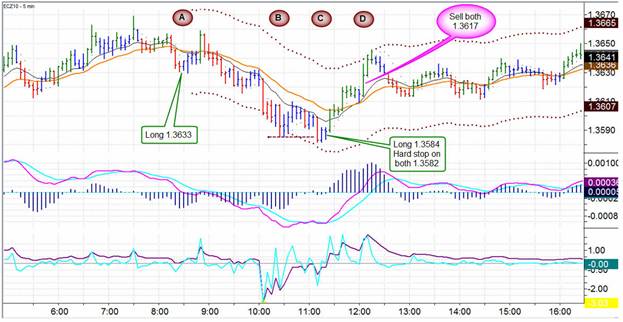
On Thursday, November 18, I was catching up on my office work using my laptop, while running a few day-trades, one after another, on a big screen. The 25-minute chart of the December Euro (not shown) was in an uptrend, and I bought a pullback below value on the 5-minute chart at 1.3633 (point A). Then, before I could grab a quick profit, the Euro reversed and my trade went under water.
I monitored my growing loss, expecting a bounce. Finally, in area B-C I observed a bullish divergence. When prices penetrated the low B by a tiny margin in area C, I decided to double up and put a hard stop at 1.3582 – the exact level of the low C. I bought my second contract at 1.3584, meaning my risk on the second trade was only 2 ticks.
Prices rallied from that bullish divergence, and in area D I sold both contracts at 1.3617. My loss on the first contract was reduced to -$200, my gain on the second became $412.50, for a total gain of $212.50 ($201 after commissions and fees). Had I just banged out of the first contract at any time during that slide, I’d have taken a loss. Doubling up at a good spot turned a losing trade into a winner.
To repeat my rules for doubling up:
• It is acceptable only for relatively small positions. If the size of your open loss has you feeling stressed, then definitely no doubling.
• Double up only after you see good technical signals
• Place a hard stop on both halves of the trade as soon as you add the second position – a must!
• Handle both positions as a single trade, monitor its average price, and get out as soon as you cut your loss.
I hope this brief discussion adds an extra technique to your toolkit. Also, please visit to www.spiketrade.com to see other discussions like this throughout the week.
Dear Trader,
The stock market has become more volatile due to many fundamental uncertainties. Trading in 2010 is much harder than it was in 2009. Many traders are responding to the jumpiness of the market by shortening their horizons – switching to very short-term swing trading and even day-trading.
Today I would like to look into one of the techniques popular among experienced day-traders – doubling down on a losing position. This brings down the average cost and allows you to get out of a losing trade at a profit. This technique is absolutely deadly in inexperienced hands – all it will do is double up your losses. It is only recommended for experienced traders with excellent discipline. The piece that follows initially appeared on SpikeTrade.com.
First point – doubling down is only recommended for relatively small-size losing trades. If you are in a large enough trade that the loss is stressing you – then you absolutely should not add to that trade and increase your stress level. Doubling down is acceptable only when you feel relaxed and unperturbed, even while your trade is under water. This is a key factor that almost everybody overlooks – doubling down is not just a technical trick; it is acceptable only for relatively small, unstressful trades.
Next, the time to double up is when your losing long trade is hanging just above a bottom at which you are determined to draw a firm line. You must say: my hard stop goes here, and if my trade slides down to this level, I am out, automatically.
Let me illustrate what I mean by showing a very recent trade – or rather a pair of trades.
On Thursday, November 18, I was catching up on my office work using my laptop, while running a few day-trades, one after another, on a big screen. The 25-minute chart of the December Euro (not shown) was in an uptrend, and I bought a pullback below value on the 5-minute chart at 1.3633 (point A). Then, before I could grab a quick profit, the Euro reversed and my trade went under water.
I monitored my growing loss, expecting a bounce. Finally, in area B-C I observed a bullish divergence. When prices penetrated the low B by a tiny margin in area C, I decided to double up and put a hard stop at 1.3582 – the exact level of the low C. I bought my second contract at 1.3584, meaning my risk on the second trade was only 2 ticks.
Prices rallied from that bullish divergence, and in area D I sold both contracts at 1.3617. My loss on the first contract was reduced to -$200, my gain on the second became $412.50, for a total gain of $212.50 ($201 after commissions and fees). Had I just banged out of the first contract at any time during that slide, I’d have taken a loss. Doubling up at a good spot turned a losing trade into a winner.
To repeat my rules for doubling up:
• It is acceptable only for relatively small positions. If the size of your open loss has you feeling stressed, then definitely no doubling.
• Double up only after you see good technical signals
• Place a hard stop on both halves of the trade as soon as you add the second position – a must!
• Handle both positions as a single trade, monitor its average price, and get out as soon as you cut your loss.
I hope this brief discussion adds an extra technique to your toolkit. Also, please visit to www.spiketrade.com to see other discussions like this throughout the week.